There’s a version of marketing that interrupts people. And there’s a version that attracts them.
Content marketing is the second kind.
That distinction sounds simple. But the implications — for how you build an audience, how you spend your budget, and how durable your business becomes over time — are enormous. Most businesses default to interruption marketing not because it works better, but because it’s faster and more intuitive to spend money reaching people than to invest time earning their attention.
Content marketing asks you to flip that logic entirely. And for the businesses willing to do it, the compounding returns are unlike anything a paid ad can produce.
Here’s what it actually means — and how to build a strategy around it that doesn’t collapse the moment you stop posting.
The Definition Nobody Disputes (And What It Actually Implies)
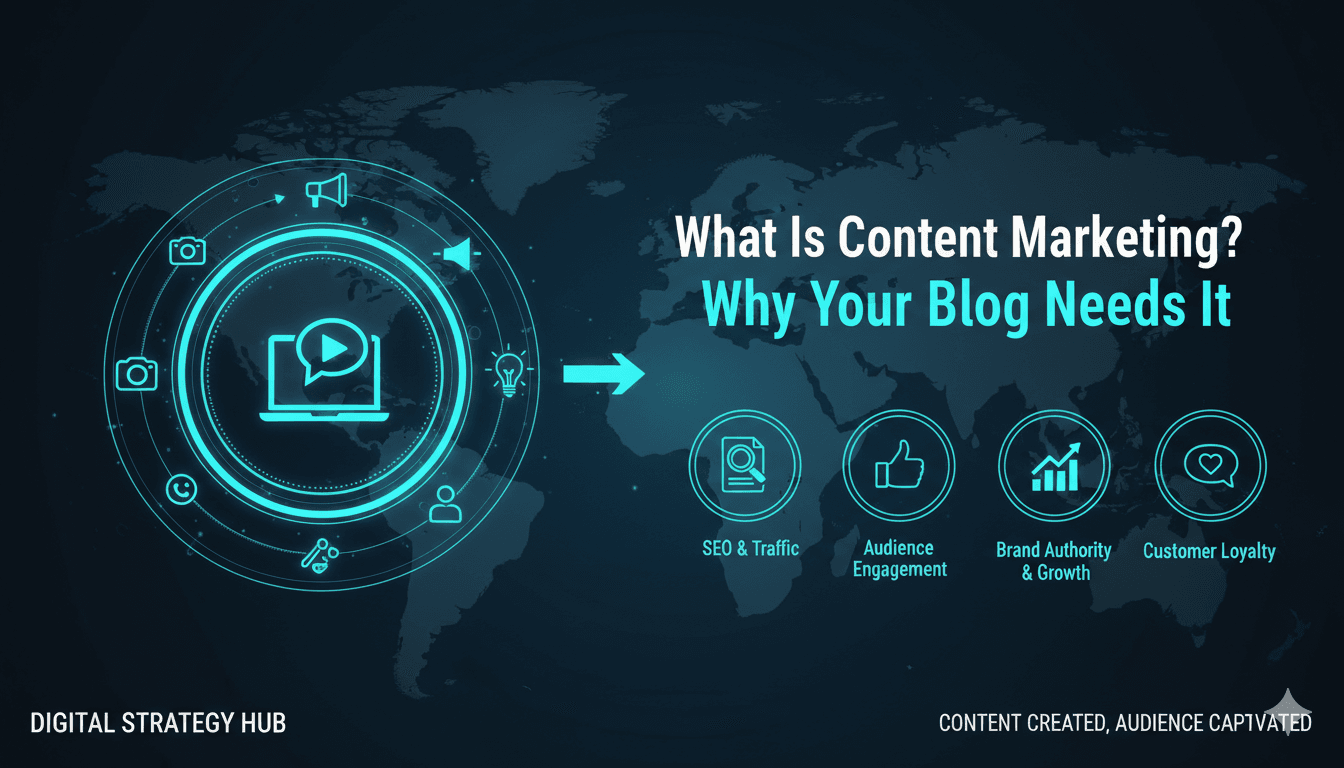
Content marketing is the practice of creating and distributing valuable, relevant content to attract and retain a specific audience — with the long-term goal of driving profitable customer action.
The operative word in that definition is valuable. Not promotional. Not branded. Not “here’s why our product is great.” Valuable to the reader, viewer, or listener on their own terms — useful enough that they’d seek it out even if your company name wasn’t attached.
This is what separates content marketing from advertising at a structural level. An ad is a message you pay to put in front of someone. Content marketing is a resource someone chooses to find, read, and share because it genuinely helps them. The channel may look similar — a blog post versus a display ad, a YouTube video versus a pre-roll — but the relationship between creator and audience is fundamentally different.
Advertising interrupts. Content marketing earns.
That earning process is slower. It requires patience, consistency, and the discipline to create things that help your audience before they’ve given you anything. But it produces something advertising can’t: an audience that trusts you, returns to you, and eventually buys from you because of that accumulated trust rather than because they happened to see your ad at the right moment.
Why “Just Running Ads” Has a Hidden Cost Most Businesses Ignore
To understand why content marketing matters, you need to understand what it’s replacing — and what the alternative actually costs in the long run.
Paid advertising works on a simple mechanic: you put money in, you get impressions and clicks out. The moment you stop putting money in, the traffic stops. There is no residual value. A Facebook campaign that spent $50,000 and drove $150,000 in revenue leaves behind exactly nothing when the budget runs out — no asset, no audience, no lasting advantage.
Content marketing works on a different mechanic entirely. A well-written blog post costs time to create and a modest amount to publish. Then it sits on your site, indexed by Google, answering a question your target customer is asking. It earns traffic in month one, month six, and month three years from now — without any additional spend. The content is an asset. Assets appreciate. Ad spend evaporates.
The analogy that makes this concrete: running paid ads is like renting an apartment. It works while you’re paying, and the moment you stop, you’re back to zero with nothing to show for the rent. Content marketing is like building a house. Slower, more upfront effort, but when it’s done, you own something — something that generates value whether or not you’re actively working on it.
This is what people mean when they say content marketing “compounds.” Each piece of content you publish adds to the foundation. Ten good articles rank in Google and collectively drive traffic. Fifty articles create a content library that covers your niche comprehensively — making your site the authoritative destination your audience returns to rather than a page they visited once.
The trap is that compounding requires time most businesses aren’t willing to give. They try content marketing for three months, don’t see results, and pivot back to ads. Then they try again in a year. Then again. They never stay long enough for the compounding to kick in, and they conclude content marketing “doesn’t work” — when what they experienced was simply the unavoidable lag between effort and return that every content strategy has.
The Four Forms Content Marketing Actually Takes
“Content marketing” is an umbrella. Under it sit several distinct formats, each with different strengths, audiences, and resource requirements.
Blog and long-form written content is the foundation for most businesses, because search engines index written text and distribute it for free over time. A blog post that ranks on page one of Google for a relevant query delivers qualified traffic indefinitely — people who are actively looking for what you offer, not passively scrolling past your ad. The investment is primarily time: research, writing, editing, and publishing on a consistent schedule.
Video content reaches audiences who won’t read. YouTube is the world’s second-largest search engine — people go there specifically to learn things, find reviews, and solve problems. A well-produced tutorial or explainer video can drive qualified traffic from YouTube searches for years, and it humanizes your brand in a way written text rarely achieves. The barrier is higher (equipment, editing, on-camera comfort), but the audience is enormous and the competition on specific niche queries is often lower than you’d expect.
Email newsletters are the most underrated form of content marketing, because they’re the only format where you own the distribution channel. Social media platforms can change their algorithm and cut your reach overnight. Google can update its ranking criteria and drop your traffic. But your email list belongs to you — nobody can take it away or throttle your access to it. A newsletter with 5,000 engaged subscribers is a more valuable asset than a social media account with 50,000 followers who never actually read what you post.
Social media content — threads, short-form video, carousels — is best understood as distribution and discovery rather than content marketing itself. Social platforms have short content lifespans (a tweet is forgotten in hours, a LinkedIn post in days) and algorithmic distribution you don’t control. Used strategically, social content drives people toward your longer-form assets — your blog, your newsletter, your YouTube channel. Treated as the end destination, it’s a treadmill that never stops.
The Strategy That Compounds vs. The Content That Doesn’t
Publishing content and doing content marketing are not the same thing. The internet is full of blogs that post inconsistently, cover topics at random, and wonder why their traffic never grows. Content that compounds has three qualities that random publishing lacks.
It targets specific, searchable questions. Every piece of content should begin with a question your audience is actually typing into Google. Not a question you think is interesting, not a topic you feel like writing about — the specific language real people use when they’re looking for the answer you can provide. Keyword research isn’t optional in content marketing. It’s the difference between publishing into a vacuum and publishing into active demand.
It builds topical authority, not just individual articles. Google doesn’t just rank pages — it evaluates the depth of a site’s expertise on a topic. A site with fifteen interlinked articles covering every angle of email marketing is treated as more authoritative than a site with one great email marketing article. The implication: pick a core set of topics and cover them thoroughly before moving on. Breadth without depth is a recipe for mediocrity at scale.
It has a clear conversion path. Content marketing that doesn’t move readers toward something — a newsletter signup, a product, a service inquiry — is brand awareness, not a business strategy. Every piece of content you publish should have a next step. What do you want the reader to do after they’ve finished reading? If the answer is “nothing in particular,” you’ve published content. You haven’t done content marketing.
Building a Strategy That Actually Survives Contact With Reality
The gap between “I should do content marketing” and “I’m consistently producing content that grows my business” is where most people get stuck. Here’s how to close it without burning out in month two.
Start with one format and master it before expanding. The instinct is to be everywhere — blog, newsletter, YouTube, TikTok, podcast, LinkedIn — simultaneously. This produces mediocre content everywhere instead of excellent content somewhere. Pick the format that matches how you naturally communicate and that your audience actually consumes. Do it well for six months before adding another channel.
Set a publishing cadence you can sustain permanently. One high-quality article per week is vastly more effective than three articles per week for a month followed by silence for two months. Search engines reward consistency. Audiences develop habits around consistency. The cadence that matters isn’t ambitious — it’s sustainable.
Treat distribution as half the job. Writing the content is the first half. Getting it in front of people is the second. Most beginners publish and wait. Most experienced content marketers publish and then actively distribute — sharing in relevant communities, repurposing across formats, building internal links from existing content, and pitching the piece to publications that might feature it. Content that nobody finds is content that doesn’t work regardless of how good it is.
Measure what leads to revenue, not what feels good. Page views are easy to optimize for and almost entirely irrelevant. The metrics that matter are email subscribers generated from organic traffic, conversion rate on content-adjacent landing pages, and repeat visit rate — the percentage of readers who come back. These tell you whether your content is building a relationship or just attracting one-time visitors who forget you exist immediately.
Why 2026 Is Actually a Good Time to Start
The emergence of AI-generated content has had a paradoxical effect on content marketing: it’s made genuinely good, original, experience-driven content more valuable than ever, because the baseline of mediocre content has flooded every niche.
When every competitor can spin up fifty AI-generated articles overnight, the differentiator is no longer volume. It’s specificity, real experience, original analysis, and the kind of earned trust that only comes from consistently helping an audience over time. Google’s E-E-A-T framework — Experience, Expertise, Authoritativeness, Trustworthiness — was designed precisely to elevate content that demonstrates genuine knowledge over content that merely assembles words competently.
The businesses that will win at content marketing in 2026 and beyond are the ones that treat their content as a genuine product — something they’re proud of, something that says something real, something that earns the reader’s time rather than merely competing for it.
That bar is actually lower to clear than it sounds. Because most content is still mediocre. The question is whether yours will be.
The Bottom Line
Content marketing is not a tactic. It’s a compounding business asset that takes time to build and becomes increasingly difficult for competitors to replicate as it matures.
It requires patience that paid advertising doesn’t. It rewards consistency that most businesses don’t maintain. And it builds the kind of audience relationship — trust earned through repeated genuine helpfulness — that no ad budget can manufacture.
Start with one channel. Target real questions. Publish on a cadence you can sustain. Distribute actively. Stay long enough for the compounding to work.
The businesses that did this three years ago are reaping the returns now. The ones that start today will be in that position in three more years.
The only bad time to start is later.
Up next: How to Write a Blog Post That Ranks on Google — a step-by-step process covering keyword selection, content structure, on-page SEO, and the internal linking strategy that builds authority over time.