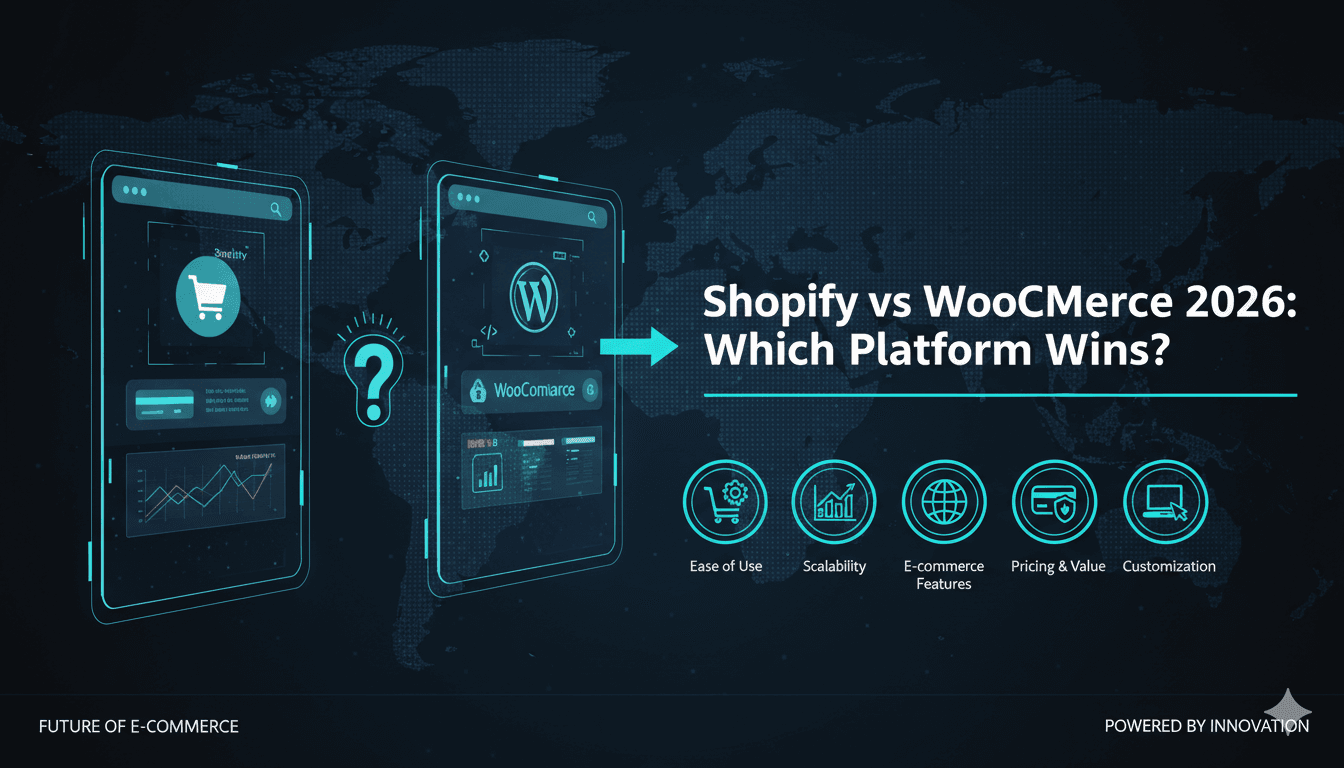
Let’s get the uncomfortable part out of the way first.
Every “Shopify vs WooCommerce” comparison you’ll find on the first page of Google has a financial incentive to recommend one over the other. Hosting companies that earn affiliate commissions from WooCommerce hosting plans tend to favor WooCommerce. Shopify-adjacent agencies tend to favor Shopify. The recommendations look like analysis, but the conclusion was usually decided before the article was written.
This one is different, because the honest answer is that both platforms are genuinely good — and the right choice depends entirely on your situation, not on which company paid a higher affiliate rate.
Here’s the comparison without an agenda.
The Fundamental Difference Nobody Explains Clearly
Before comparing features and pricing, you need to understand what each platform actually is at an architectural level — because this shapes everything downstream.
Shopify is a SaaS platform. You pay a monthly subscription, and in exchange Shopify handles your hosting, security, SSL certificate, PCI compliance, software updates, and server infrastructure. You rent a fully managed environment. The trade-off is that you’re operating inside Shopify’s rules — customization has limits, and if Shopify changes its pricing, policies, or decides to sunset a feature, you’re subject to that decision.
WooCommerce is an open-source plugin that runs on top of WordPress. It’s free to install, but “free” is doing a lot of work in that sentence. You supply the hosting, the domain, the SSL certificate, the security, the backups, and the ongoing maintenance. You own the entire stack — which means full control and full responsibility.
A useful analogy: Shopify is renting a fully serviced apartment — everything works, someone else fixes the plumbing, and you pay a predictable monthly rate. WooCommerce is owning a house — more space, more freedom, more customization, but you’re calling the plumber yourself.
Neither is inherently better. The right one depends on whether you want to spend your time running a store or running a server.
Cost: The Number Everyone Gets Wrong
This is where most comparisons mislead beginners, because they compare headline prices rather than total cost of ownership.
Shopify’s Real Costs
Shopify’s plans start at $39/month (monthly billing) or $29/month on annual billing. The mid-tier plan runs $105/month. Those prices include hosting, security, and most core features.
The hidden cost most merchants miss: transaction fees. If you use any payment processor other than Shopify Payments, Shopify charges an additional 2% fee on every sale (Basic plan), 1% (Shopify plan), or 0.5% (Advanced plan). On $10,000/month in revenue, that’s an extra $200 per month on the Basic plan — quietly eroding margins that you probably didn’t factor into your projections.
If you use Shopify Payments, these fees disappear. But Shopify Payments is only available in certain countries — which is a meaningful limitation for sellers in Southeast Asia, much of Africa, or parts of Latin America.
WooCommerce’s Real Costs
WooCommerce itself is free. But a production-ready store isn’t.
A realistic minimum setup in 2026 looks like this:
| Item | Monthly Cost |
|---|---|
| Managed hosting (Cloudways, SiteGround) | $15–$35 |
| Domain name | ~$1.50 |
| SSL certificate | Free (via host) |
| Premium theme (one-time, amortized) | $5–$15 |
| Essential plugins (SEO, security, backup) | $10–$30 |
| Total | $30–$80/month |
A fully-featured store with premium plugins — page builders, advanced analytics, email marketing integration, subscriptions — can run $80–$200/month before you factor in developer time.
The key difference is that WooCommerce costs are primarily fixed, while Shopify’s costs scale with revenue via transaction fees. For stores above $50K/month in revenue using Shopify Payments, the cost comparison between the platforms becomes nearly neutral. Below that threshold, WooCommerce is usually cheaper. Above it, using Shopify Payments, Shopify often wins on total cost of ownership.
The honest summary: WooCommerce wins on raw cost if you’re technically capable and use a third-party payment processor. Shopify wins on cost predictability and ease — you always know what you’re paying, with no surprise infrastructure bills.
Ease of Use: A Gap That Actually Matters
This is the area where Shopify’s advantage is most clear-cut, and where WooCommerce is most frequently oversold to beginners.
Setting up a Shopify store is genuinely fast. Sign up, pick a theme, add products, connect a payment method, and you’re live. The whole process takes an afternoon if you’re organized. The interface is polished, intuitive, and designed to guide non-technical users through every step. Customer support is available 24/7 via chat.
Setting up WooCommerce requires installing WordPress, choosing and configuring a hosting environment, installing WooCommerce, setting up an SSL certificate, configuring payment gateways, and typically installing several additional plugins before your store resembles something functional. Each of those steps is documented, and none of them are impossible — but they require time, patience, and a higher comfort level with technology than Shopify demands.
WooCommerce requires more work to set up, with users needing to find a website domain and host, install plugins, and potentially add some basic code to modify their store.
Where WooCommerce catches up is in long-term flexibility. Once it’s set up, a technically comfortable merchant can modify almost anything — the checkout flow, the product page layout, the database structure, the email templates. Shopify’s customization is meaningful but operates within guardrails that WooCommerce doesn’t have.
If you’re a first-time store owner with no technical background, Shopify will save you weeks of frustration. If you’re a developer or someone running a complex operation with specific technical requirements, WooCommerce’s flexibility will eventually pay for the setup overhead.
Scalability: Different Ceilings, Different Floors
WooCommerce powers 36% of all e-commerce sites globally, but Shopify merchants generate significantly higher average revenue per store. That statistic tells you something important: WooCommerce is widely deployed, but Shopify tends to attract the stores that are actively growing and optimizing for revenue.
Shopify’s scaling story is largely frictionless. As your traffic and order volume grows, Shopify’s infrastructure scales automatically — you don’t provision new servers, worry about database optimization, or manage CDN configuration. The platform handles it. Shopify Plus, their enterprise tier, starts at $2,500/month and handles merchants processing hundreds of millions in annual revenue.
Shopify’s $39–$399/month all-inclusive pricing becomes more cost-efficient at high volume because infrastructure, security, and PCI compliance are all bundled.
WooCommerce’s scaling story is more nuanced. The platform itself can handle high-volume stores — many large merchants run WooCommerce at serious scale. But achieving that scale requires progressively more technical investment: optimized hosting, database caching, CDN configuration, and usually a developer who knows what they’re doing. The ceiling is high, but the climb is steeper.
The practical implication: if you’re building a small-to-medium store and want to spend your time on products and marketing rather than server management, Shopify’s scaling is a genuine advantage. If you have technical resources and want full control over your infrastructure as you grow, WooCommerce scales adequately with the right setup.
SEO: Closer Than You’d Expect
WooCommerce has a reputation for SEO superiority over Shopify, and in past years that reputation was mostly deserved. Today, the gap has narrowed considerably.
WooCommerce’s SEO advantage comes from running on WordPress — which, combined with plugins like RankMath or Yoast SEO, offers granular control over every SEO element. URL structures, breadcrumbs, schema markup, content architecture — all of it is configurable with minimal friction.
Shopify has improved its SEO capabilities significantly, and for most standard use cases, it’s now competitive. The areas where Shopify still lags: URL structure customization (you can’t remove /products/ from product URLs without workarounds), and the fact that a blog on Shopify is always a secondary feature, not a primary content engine the way WordPress is.
If content marketing and SEO are central to your customer acquisition strategy — if you’re building a blog alongside your store and plan to earn traffic through articles — WooCommerce on WordPress has a meaningful structural advantage. If your customer acquisition is primarily through paid ads or social media, Shopify’s SEO limitations rarely matter in practice.
The 2026 Factor: AI Features
Shopify Magic — the brand umbrella for Shopify’s AI features — has expanded to cover virtually every merchant workflow, including product descriptions, email campaigns, and customer segmentation. WooCommerce relies on third-party plugins for comparable AI features, adding $30–$150/month in additional tool costs.
This gap is real and growing. Shopify’s native AI tools are deeply integrated with store data — they understand your products, your customers, and your sales history in ways that a bolted-on third-party plugin can’t replicate cleanly. For merchants who want AI assistance without spending time configuring integrations, Shopify’s bundled approach has a measurable efficiency advantage in 2026.
WooCommerce’s counter-argument — and it’s a legitimate one — is that the open ecosystem means you can integrate any AI tool, including custom-built solutions, without platform restrictions. For technically sophisticated merchants, that flexibility has value. For most store owners, it’s complexity they don’t need.
The Decision Framework: Which One Is Right for You?
Rather than a blanket recommendation, here’s an honest decision tree:
Choose Shopify if:
- You’re launching your first store and want to be live quickly
- You have no technical background and no developer on your team
- You’re primarily selling physical products with a straightforward catalog
- You want predictable monthly costs and no infrastructure surprises
- You’re in a country where Shopify Payments is available
Choose WooCommerce if:
- You already have a WordPress site with established content and SEO
- You have technical resources — either your own skills or a developer relationship
- You need deep customization that Shopify’s ecosystem can’t accommodate
- You’re using a payment processor that Shopify charges transaction fees for
- Content marketing is central to your strategy and you want WordPress as your foundation
The one scenario where neither is obviously better: mid-size stores doing $50K–$500K/month in revenue with mixed technical resources. At that scale, both platforms are viable, total cost of ownership is similar, and the decision comes down to team capability and specific feature requirements.
The Bottom Line
Shopify wins on ease of use, support, built-in AI features, and the reliability of a managed platform. WooCommerce wins on customization depth, content integration, and cost flexibility — especially for stores using non-Shopify payment processors.
The question that cuts through the noise: how much of your time do you want to spend managing your platform versus running your business?
If your answer is “as little as possible,” the answer is Shopify. If your answer is “I want full control and I’m comfortable with the technical overhead,” the answer is WooCommerce.
Both choices have built eight-figure businesses. Pick the one that matches how you actually want to operate — not the one with the prettier landing page.