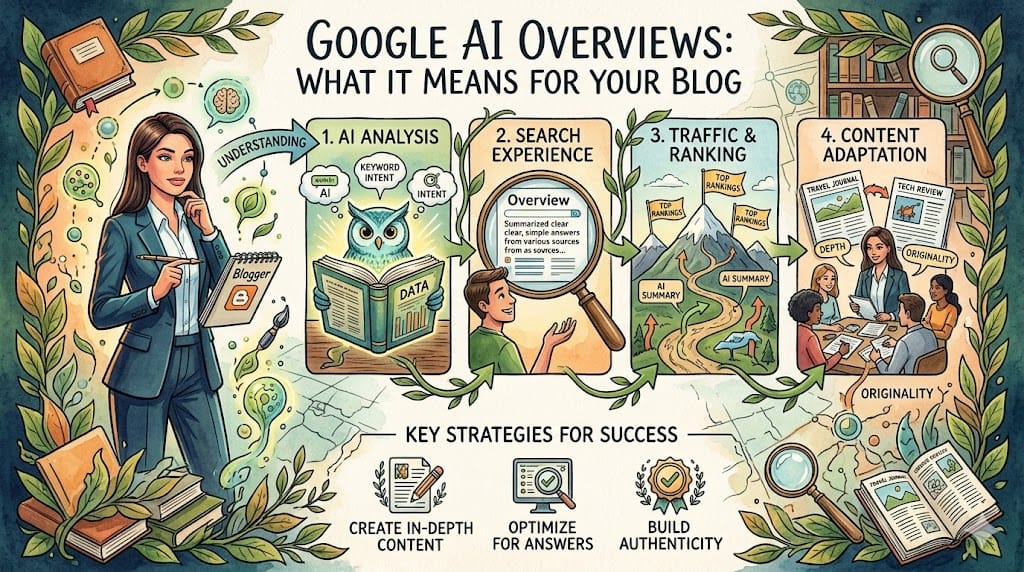
If your blog traffic has dropped in the last twelve months and you haven’t changed anything, Google’s AI Overviews are almost certainly part of the explanation.
This isn’t a theory or a concern for the future. The data is in, it’s consistent across dozens of independent studies, and it points in one direction. The way organic search traffic flows from Google to publisher websites has structurally changed — and the content strategies that worked reliably in 2022 and 2023 are producing measurably different results in 2026.
The good news — and there genuinely is good news — is that this shift creates winners as well as losers. Understanding which side of that line your blog is on, and what to do about it, starts with understanding what AI Overviews actually are and how they’ve changed search behavior.
What AI Overviews Are and How They Work
Google’s AI Overviews — originally launched as Search Generative Experience (SGE) at Google I/O in May 2023, then rolled out globally in May 2024 — are AI-generated summaries that appear at the top of search results pages, above the traditional blue links.
When you search for something informational — “how to reduce bounce rate,” “what is compound interest,” “best tools for keyword research” — Google’s AI reads multiple web pages, synthesizes the key information, and presents a summary answer directly on the results page. Below the summary, it shows a small carousel of the sources it drew from. Below that, eventually, are the traditional organic results.
The user gets an answer without clicking anything. That’s the mechanic. Everything downstream flows from it.
As of early 2026, AI Overviews appear on approximately 48% of tracked queries globally — up from 31% just twelve months earlier, representing a 58% year-over-year increase in coverage. In certain verticals, the penetration is dramatically higher: education queries now trigger AI Overviews 83% of the time, B2B tech queries 82%, and restaurant queries 78%, according to BrightEdge’s twelve-month analysis.
The Traffic Impact: What the Data Actually Shows
Let’s put specific numbers to the impact, because vague warnings about “declining traffic” undersell how significant the shift has been.
Seer Interactive’s September 2025 study — tracking 25.1 million organic impressions across 3,119 informational queries from 42 organizations — found that organic CTR dropped 61% when AI Overviews were present, falling from 1.76% to 0.61%. To translate that: if a query used to send 100 visitors to your article each month, the same query with an AI Overview now sends roughly 35.
Pew Research’s March 2025 analysis, tracking 68,000 real search queries, found that users clicked on results only 8% of the time when AI summaries appeared — compared to 15% without them.
Zero-click searches grew from 56% to 69% between May 2024 and May 2025 alone — meaning more than two-thirds of Google searches now end without a single click to any external website.
Across a network of 64 publisher sites, organic search clicks declined 42% cumulatively since AI Overviews expanded broadly through Q4 2025.
US referrals from organic Google search were down 38% year over year by late 2025, with publishers who specialize in lifestyle and utility content — exactly the type AI Overviews answer most readily — experiencing the steepest drops.
These numbers are not outliers. They’re consistent across Ahrefs, Similarweb, Chartbeat, SparkToro, and BrightEdge data. The trend is established, not emerging. And the relevant question for a blog owner in 2026 is not “will this affect me?” but “how do I operate effectively inside this new reality?”
The Opportunity Inside the Problem
Here’s the number most coverage of AI Overviews doesn’t lead with — because it complicates the simple narrative of decline.
Brands cited inside AI Overviews earn 35% more organic clicks and 91% more paid clicks compared to non-cited brands on the same queries.
Read that again. Being cited in an AI Overview generates more qualified traffic than ranking third in traditional organic results — on the same query, at the same time, where uncited brands are experiencing the full 61% CTR collapse.
The AI Overview citation is the new position zero. It’s more powerful than the featured snippet ever was, because it appears higher on the page, occupies more visual space, and carries the implicit endorsement of Google’s AI choosing your content as one of only three to five sources worth referencing.
This means the strategic question has shifted from “how do I rank on page one?” to “how do I become one of the three sources Google’s AI trusts enough to cite?” These are related questions, but they’re not identical — and the gap between them is where the opportunity lives for blogs that adapt.
Which Content Gets Hit Hardest
Not all content is equally affected, and understanding the pattern helps you prioritize where to focus.
AI Overviews overwhelmingly target informational queries — definitions, how-to guides, explanations, comparisons, tutorials. If someone is asking a question that has a reasonably clear answer, Google’s AI will attempt to provide that answer without requiring a click. This is precisely the content most blogs are built on.
Transactional and commercial queries — where someone is ready to buy, comparing specific products, or looking for pricing — trigger AI Overviews far less frequently. A search for “buy running shoes size 11” or “Shopify vs BigCommerce pricing 2026” is less likely to be answered by an AI summary than a search for “how does DNS work.”
Breaking news and timely content is significantly less affected. AI Overviews appear for only about 15% of news-related searches, compared to much higher rates for evergreen informational content — and breaking news traffic actually grew 103% across one major publisher network between late 2024 and early 2026 as a result.
Highly specific, experience-based, and opinion content — reviews, first-person case studies, detailed personal analyses — is harder for AI to synthesize from generic sources and more likely to be cited as a unique perspective.
The practical implication: blogs that are built almost entirely on evergreen informational content (“what is X,” “how to Y”) are the most exposed. Blogs that mix informational content with original research, personal experience, timely analysis, and strong editorial perspective are more resilient.
What to Optimize For in 2026: The Citation Framework
Getting cited in AI Overviews requires a different optimization approach than ranking in traditional search. The good news: these approaches are complementary, not conflicting.
Write direct answer blocks. AI systems extract opening sentences heavily when building summaries. Structure every section of your article with a direct, concise answer in the first one to two sentences, followed by supporting detail. This is sometimes called the “inverted pyramid” structure — conclusion first, evidence second. It improves readability for humans and dramatically increases the probability that AI will extract your phrasing as the summary.
A practical test: take any H2 heading in your draft article and cover the paragraph below it. Can someone read just the heading and first two sentences and know the core answer? If not, your opening sentences aren’t doing their job.
Build topical authority, not just individual articles. Google’s AI cites sources that it has established as authoritative on a topic — not just sources that rank for individual keywords. A site with fifteen well-interlinked articles covering every angle of SEO is treated as more trustworthy than a site with one great SEO article. This makes content clustering — publishing several interlinked articles around a core topic — a citation strategy, not just an SEO tactic.
Use data, statistics, and original research. AI systems prefer citing sources that ground claims in evidence. Even citing third-party research (with attribution) makes your content more citable than content that makes the same claims without evidence. Original data — your own surveys, case studies, or analysis — is even more valuable because it’s genuinely unique and therefore genuinely useful to an AI that’s trying to synthesize information from multiple sources.
Demonstrate E-E-A-T explicitly. Google’s content quality framework — Experience, Expertise, Authoritativeness, Trustworthiness — shapes what the AI cites as well as what traditional search ranks. This means adding author bios with verifiable credentials, citing your own experience explicitly (“In running this blog for three years…”), linking to authoritative external sources, and keeping your content updated with accurate, current information. The AI has been trained to prefer content that demonstrates real expertise over content that merely organizes information competently.
Target question-format keywords. Queries phrased as questions — “how does X work,” “what is the best Y for Z,” “why does A cause B” — are the most common triggers for AI Overviews. Structuring your content to answer specific questions directly (including using FAQ sections with clear, concise answers) makes your content naturally aligned with the query types that trigger the feature most frequently.
Diversifying Beyond Google: The Structural Shift That’s Already Happening
The publishers who are navigating this best aren’t trying harder at traditional Google SEO. They’re treating Google as one distribution channel among several — and investing in channels where AI summarization is less of a structural threat.
Google Discover traffic grew 30% over the same period that traditional search traffic fell, and is now driving roughly equal traffic to traditional web search at some publishers. Discover operates on engagement signals rather than keyword matching — strong headlines, compelling visuals, content freshness, and demonstrated reader engagement drive distribution, not keyword density.
Email newsletters remain the highest-leverage channel for direct audience ownership. No algorithm mediates between you and your subscribers. No AI summarizes your newsletter in someone else’s search results. Building an email list is more important in 2026 than it has been at any point in the previous decade precisely because it’s the one channel Google can’t disintermediate.
YouTube’s growing role as a search engine — and one where AI Overviews appear in approximately 15% of queries compared to 48% on Google web search — makes video content an increasingly strategic complement to written content for topically authoritative blogs.
Most publishers now plan to invest more effort in YouTube in 2026, with a net positive score of 74 among media leaders surveyed — up from 52 the previous year.
The Honest Assessment
Google AI Overviews are not a problem you can SEO your way out of with better title tags and more internal links. The structural change is real, the traffic impact is documented, and the trend is not reversing.
But the blogs that will win in this environment are not the ones that panic-pivot away from content entirely. They’re the ones that:
- Produce content with genuine expertise and original perspective that AI systems cite rather than summarize
- Build topical authority deep enough that Google’s AI treats them as a trusted source, not just a ranking page
- Distribute through multiple channels so that Google’s algorithmic decisions are one input, not the entire foundation
- Track share of voice and citation frequency, not just rankings and traffic, as the primary success metrics
The old success metric — “I rank first for this keyword, therefore traffic will come” — has a shorter shelf life than it used to. The new success metric — “I am the source Google’s AI cites on this topic” — is harder to earn and harder to lose.
That’s where the work is now.
Up next: Frontend vs Backend vs Full-Stack Developer — a clear breakdown of the three developer roles, what each requires, and how to choose your path.