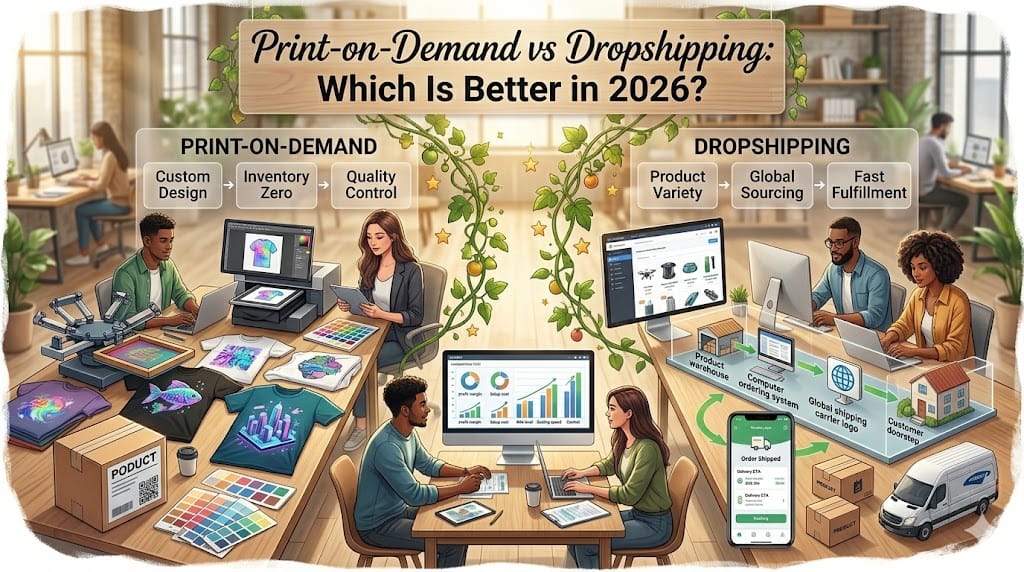
Both models promise the same thing: sell products online without holding inventory, without a warehouse, without upfront stock risk.
That promise is real. But beneath the shared surface, print-on-demand and dropshipping are structurally different businesses — with different economics, different ceilings, different failure modes, and different types of work. Choosing between them based on the shared promise rather than the structural differences is why so many beginners pick the wrong one for their situation and spend months wondering why it isn’t working.
Here’s the honest comparison.
The Core Mechanic of Each Model
Before the numbers and trade-offs, a precise description of how each model actually works — because the surface similarities hide meaningful operational differences.
Dropshipping: You list products from a supplier’s catalog in your online store. When a customer orders, you forward the order (manually or automatically through an app like DSers or AutoDS) to the supplier, who ships directly to your customer under a plain label. You never touch the product. Your margin is the difference between what your customer paid and what the supplier charged you.
The product exists before you sell it. You’re reselling an existing manufactured item. Thousands of other stores may be listing the exact same product from the same supplier catalog. Your differentiation comes from marketing, positioning, and the customer experience you build around a commodity product.
Print-on-demand (POD): You create designs. A POD supplier (Printful, Printify, Gelato) prints your design onto a blank product — a t-shirt, a mug, a tote bag, a poster — only when a customer orders it. No order, no production. The product is unique to your design. You never touch inventory. Your margin is the difference between your selling price and the POD supplier’s per-unit production cost.
The key distinction: in dropshipping you’re selling someone else’s existing product. In print-on-demand, you’re creating a product that didn’t exist before your design. That difference shapes everything downstream — the margin structure, the brand potential, the competition dynamics, and the type of work required.
Margin Comparison: The Numbers That Actually Matter
This is the section most comparison articles get wrong by using best-case numbers for one model and realistic numbers for the other. Here’s an honest side-by-side using representative 2026 figures.
Typical dropshipping margin example:
A phone case sourced from a Chinese supplier via AliExpress costs $3.50. You sell it for $19.99. Gross margin: $16.49 per unit, or about 82%.
That looks excellent until you account for Facebook or TikTok ad spend. In 2026, customer acquisition costs for generic consumer products through paid social typically run $15–$30 per conversion in competitive niches. At $20 CAC, your profit on a $19.99 phone case is roughly $0 after product cost. At $15 CAC, you net $1.49 per unit.
This is why dropshipping margin discussions that cite “80% gross margins” are technically accurate and practically misleading. The gross margin is high. The net margin — after customer acquisition — is often very thin to negative for undifferentiated products in competitive niches.
Typical POD margin example:
A custom-designed t-shirt costs $14–$16 to produce through Printful (including printing and fulfillment). You sell it for $35. Gross margin: $19–$21 per unit, or roughly 54–60%.
Lower gross margin than dropshipping on paper. But POD products are, by definition, differentiated — your design exists nowhere else. This enables organic discovery (Instagram, Pinterest, Etsy) rather than pure paid acquisition. A store with strong organic presence and email marketing might acquire customers at $8–$12 CAC versus $15–$25 for a generic dropshipping product. Net margin often exceeds dropshipping in practice, even with lower gross margin.
The honest summary: Neither model has structurally superior margins in isolation. Dropshipping has higher gross margins per unit; POD has higher net margins in practice because differentiated products support organic growth and repeat purchase. If you’re relying entirely on paid traffic for either model, the economics are challenging — the advantage goes to whoever has the better product-market fit and lower CAC.
Fulfilment Speed: Where Each Model Wins and Loses
Customer expectations around delivery speed have been permanently shaped by Amazon Prime. Free two-day shipping is the psychological anchor most buyers use to evaluate every other delivery promise.
Dropshipping from overseas suppliers typically delivers in 7–21 days for standard shipping from China. Some suppliers offer faster options (5–10 days via ePacket or similar), but these cost more and reduce margin. For the US, EU, or Australian market expecting sub-week delivery, standard overseas dropshipping creates a consistent friction point — customers accustomed to Amazon timelines find 2–3 week waits unacceptable, leading to disputes, refund requests, and negative reviews.
US/EU-based dropshipping suppliers (AutoDS domestic warehouses, Spocket, Zendrop’s US fulfillment) offer faster delivery at higher product costs, which compresses margin further. The speed vs. cost trade-off is a constant tension.
Print-on-demand from established suppliers like Printful or Gelato has improved significantly. Printful’s US and EU production facilities typically ship within 2–5 business days. Gelato operates production hubs in 32 countries — matching print location to customer location dramatically reduces both shipping time and international shipping costs. For US customers ordering from a POD store using US-based production, a 5–7 day door-to-door timeline is realistic.
Edge: POD, particularly for Western markets, when using suppliers with local production. Dropshipping from overseas suppliers remains a legitimate fulfilment speed liability that no amount of copywriting fully overcomes.
Branding Control: Building Something That Lasts
This is the dimension most directly tied to long-term business value — and where the gap between models is widest.
Dropshipping branding reality: The product arrives in generic packaging, often with the supplier’s own branding inside the box. Some suppliers offer white-label packaging for an additional fee, but this is the exception rather than the standard. The customer experience — from the box they open to the product they hold — is largely indistinguishable from what anyone else ordering from the same supplier receives.
Building a recognizable brand around a commodity product is possible — it’s what companies like Warby Parker and Away luggage did in physical retail — but it requires significant investment in storytelling, community building, and customer experience design that goes far beyond the product itself. Most dropshipping operations don’t do this, which is why most dropshipping stores are interchangeable.
Print-on-demand branding reality: The product itself is your design. Nobody else has it. A customer who buys a shirt from your store owns something uniquely yours — which is the foundation of genuine brand identity. Printful and Printify both offer branded packaging options: custom packing slips, sticker inserts, branded tissue paper, neck label replacement. These cost a small additional amount per order and produce an unboxing experience that supports brand recall and repeat purchase.
POD stores built around a strong creative identity — a specific illustration style, a niche community’s inside references, a distinctive aesthetic — can develop genuine brand loyalty. The product portfolio grows over time as you add new designs; returning customers have a reason to come back because the catalog is always evolving with new creative output.
Edge: Print-on-demand, clearly. The differentiated product is the foundation of a real brand. A dropshipping store selling the same phone cases as a hundred competitors has a much harder path to brand identity.
Effort Level and Day-to-Day Operations
Both models are described as “passive income” by people who want to sell courses about them. Neither is. But they require meaningfully different types of active work.
Dropshipping daily operations:
- Supplier monitoring: Out-of-stock items on AliExpress are common. If your supplier runs out of stock after you’ve already made sales, you have a fulfilment problem. Responsible dropshipping requires regularly checking supplier inventory levels and having backup suppliers identified.
- Customer service: “Where is my order?” is the dominant customer service query for dropshipping stores, because 7–21 day shipping timelines generate anxiety. Plan for 30–60 minutes of customer service per day for a store doing 5–10 orders daily.
- Supplier quality control: You can’t inspect products before they ship. Negative reviews and disputes from quality inconsistencies are a recurring cost of doing business.
- Price monitoring: AliExpress suppliers change prices without notice. An automated import that set your selling price at 3x product cost can become unprofitable overnight if the supplier raises their price by $5.
Print-on-demand daily operations:
- Design creation: The ongoing creative work that drives a POD business. You need to produce new designs regularly — not because the platform requires it, but because a growing, evolving catalog is how POD stores build repeat customers and organic discovery. If you’re not a designer, tools like Canva and Adobe Express have lowered this barrier significantly, but design quality still determines product salability.
- Listing optimization: Writing product titles, descriptions, and tags that rank organically on Etsy or in Google Shopping requires consistent attention.
- Customer service: Lower volume than dropshipping because fulfilment issues are rarer when using quality POD suppliers with local production. Most inquiries are about sizing, shipping timelines, or custom order requests.
The honest trade-off: Dropshipping requires more reactive work (managing supplier relationships, handling customer complaints, monitoring prices and availability). POD requires more proactive creative work (producing designs, building a portfolio, developing a brand aesthetic). Which suits you better is a personality question as much as a business one.
Scalability: Where Each Model’s Ceiling Is
Dropshipping’s scaling constraints: As volume grows, supplier reliability issues scale proportionally. Managing multiple suppliers across multiple products — monitoring stock levels, quality, and pricing for each one — becomes a significant operational overhead. Most successful dropshipping operations at scale either vertically integrate (buying inventory in bulk from their best-performing suppliers and fulfilling themselves) or transition to a white-label private label model. Dropshipping is often a stepping stone rather than a permanent operating model.
The exit path for a scaling dropshipping business typically leads to holding some inventory, which requires capital and negates the original appeal of the model.
POD’s scaling constraints: The per-unit cost of POD production is always higher than bulk manufacturing. At meaningful volume — say, 500+ units per month of a specific design — the economics of ordering inventory from a manufacturer and fulfilling yourself almost always beat POD production costs. A successful POD brand that’s hit product-market fit eventually faces the decision of whether to stay asset-light with compressed margins or invest in inventory to improve unit economics.
POD also has a creative bottleneck: the business depends on continuously producing quality designs. This scales by hiring designers, which adds cost and management complexity.
The honest summary: Neither model is designed to run unchanged at high scale. Both are excellent starting points; both eventually require evolution. POD tends to evolve toward a private label brand with some inventory; dropshipping tends to evolve toward a focused niche brand with better supply chain control.
Which Model Is Right for You: The Decision Framework
Choose print-on-demand if:
- You have (or can develop) design skills, or a clear aesthetic identity for a niche community
- You want to build a real brand with differentiated products
- You’re targeting Western markets where delivery speed expectations are high
- You’re comfortable with lower gross margins in exchange for better brand potential and organic growth
- You’re starting on Etsy, Redbubble, or Merch by Amazon alongside your own store
Choose dropshipping if:
- You’re primarily interested in testing product-market fit quickly across many different product categories
- You’re comfortable with paid advertising as your primary customer acquisition channel
- You have (or are building) genuine expertise in identifying trending products before they saturate
- You’re in a market where 7–21 day delivery expectations are more accepted
- You understand the model’s limitations and are treating it as a learning phase rather than a permanent operating model
The one scenario where POD wins unambiguously: if you’re a creator, illustrator, or community builder with an engaged audience. Selling merchandise to people who already love your work removes the customer acquisition problem entirely — and that’s the scenario where POD unit economics look best without needing to solve the hard problem of finding customers cold.
The Bottom Line
Print-on-demand and dropshipping are both legitimate starting points for an online store. Neither is inherently better. They’re optimized for different things.
Dropshipping is optimized for speed and flexibility: you can test dozens of products without creative investment, pivot quickly when trends change, and run a profitable operation if you’re skilled at paid advertising and supplier management.
Print-on-demand is optimized for differentiation and brand-building: you create something that doesn’t exist elsewhere, build a catalog that grows in value over time, and develop the kind of customer loyalty that makes a business defensible rather than purely transactional.
The question isn’t which model is better. The question is which model fits who you are, what you’re good at, and what kind of business you actually want to run.
Up next: 10 High-Demand Dropshipping Niches in 2026 — research-backed niche ideas with real demand data and manageable competition for new store owners.