Every beginner eventually hits this wall.
You’ve decided to learn programming. You’ve done enough research to know Python and JavaScript are the two obvious starting points. And now you’re spending more time debating between them than actually writing any code.
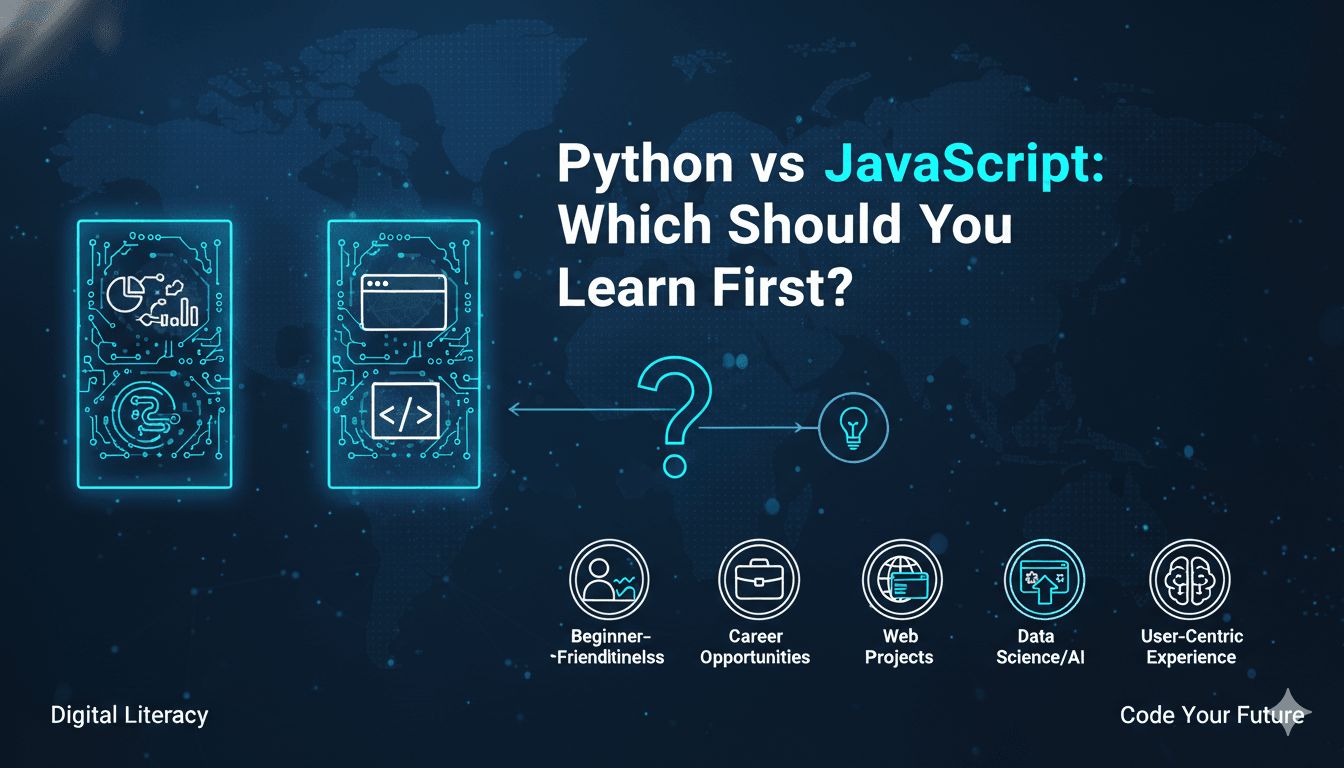
Here’s the honest answer: both are good choices, the difference matters less than most tutorials suggest, and the right answer depends entirely on one question — what do you actually want to build?
But that answer is too short to be useful, so let’s work through this properly.
Why These Two Languages Dominate the Beginner Conversation
Before comparing them, it’s worth understanding why Python and JavaScript keep showing up as the top recommendations in the first place — because it’s not arbitrary.
Python was designed with readability as a first principle. Guido van Rossum, who created it in the late 1980s, wanted a language that read almost like pseudocode — something close enough to plain English that the logic of a program was obvious even to a non-programmer. That decision has paid off enormously for learners. Python removes a lot of the ceremonial syntax that trips beginners up in other languages.
JavaScript, meanwhile, has a structural advantage that no other language can claim: it runs natively in every web browser on the planet. You don’t install anything, you don’t configure an environment, you open a browser, press F12, and you’re writing code. That accessibility is genuinely valuable for beginners who want to see results fast.
Both languages are also, objectively, among the most in-demand in the job market. Both have enormous communities, excellent documentation, and decades of learning resources. The debate is real, but it’s a high-quality problem — you’re choosing between two genuinely excellent options.
The Syntax Difference (And Why It Matters More Than You Think)
This is where the gap between Python and JavaScript is most tangible for beginners.
Here’s the same task in both languages — checking whether a number is even and printing a result:
Python:
python
number = 8

if number % 2 == 0:
    print(f"{number} is even")
else:
    print(f"{number} is odd")
JavaScript:
javascript
const number = 8;

if (number % 2 === 0) {
    console.log(`${number} is even`);
} else {
    console.log(`${number} is odd`);
}
Functionally identical. But look at what JavaScript adds: semicolons at the end of statements, curly braces to define code blocks, === instead of == for comparison, const before the variable declaration, console.log instead of print.
None of these are hard. But when you’re a beginner trying to hold ten new concepts in your head simultaneously, each one is a small additional cognitive load. Python eliminates most of that ceremony deliberately — indentation defines structure instead of curly braces, and the language enforces clean formatting by default.
The practical result: beginners tend to make fewer syntax errors in Python early on, spend more time thinking about logic rather than punctuation, and hit their first working program faster.
That said, JavaScript’s syntax isn’t arbitrary noise. Curly braces and semicolons are conventions shared by C, Java, C++, and many other languages. Learning JavaScript first means the syntax of half the world’s codebases will look familiar to you earlier.
Job Market Reality in 2026
If you’re learning to code with employment in mind, this section matters.
The honest picture is that both languages are extremely employable — but they lead to different types of roles.
Python dominates:
- Data science and machine learning (TensorFlow, PyTorch, pandas, scikit-learn are all Python-first)
- Automation and scripting
- Backend web development (Django, FastAPI, Flask)
- AI engineering — the fastest-growing category of tech roles in 2026
- Academic and research computing
JavaScript dominates:
- Frontend web development (it’s the only option — there is no alternative that runs in a browser)
- Full-stack web development (Node.js means JavaScript on the server too)
- React Native mobile development
- Browser extensions, interactive web tools, anything visual in a browser
The most striking difference right now is the AI and data science angle. If your goal is to work in machine learning, build AI pipelines, do data analysis, or get into the growing field of AI engineering, Python is not just the better choice — it’s practically the only choice. The ML ecosystem is so deeply Python-centric that trying to do serious machine learning work in JavaScript is like trying to do carpentry with a kitchen knife. Technically possible. Practically inadvisable.
On the other hand, if you want to build things that run in a browser — websites, web apps, interactive interfaces — JavaScript is irreplaceable. There is no path to frontend development that doesn’t go through JavaScript. Full stop.
A rough guide by goal:
| Goal | Start With |
|---|---|
| Web frontend / UI | JavaScript |
| Full-stack web app | JavaScript |
| Data science / analytics | Python |
| Machine learning / AI | Python |
| Automation / scripting | Python |
| Mobile app (React Native) | JavaScript |
| Backend API (either works) | Python or JavaScript |
| General programming fundamentals | Python |
The “Just Build Stuff” Test
Here’s a framework that cuts through the noise: what would you build this weekend if you already knew how?
If the answer involves anything visual in a browser — a portfolio site, a Chrome extension, an interactive tool someone can use in their phone — JavaScript. You can’t avoid it, and starting with Python means you’ll have to learn JavaScript anyway before you can build what you actually want.
If the answer involves automating something tedious on your computer, analyzing a spreadsheet, scraping some data, or experimenting with a machine learning model — Python. You’ll be productive faster, and the ecosystem will meet you exactly where you want to go.
If you genuinely don’t know what you want to build yet, and you just want to understand how programming works as a foundation for future decisions — Python. The syntax is cleaner, the mental overhead is lower, and the fundamentals translate directly to any other language you pick up afterward.
Where Each Language Falls Short
No honest comparison skips this part.
Python’s weaknesses:
Speed. Python is interpreted and dynamically typed, which makes it significantly slower than compiled languages. For most web applications and scripts this doesn’t matter — computers are fast enough that the difference is invisible. But for performance-critical systems, game engines, or low-latency financial applications, Python hits a wall.
Front-end. You simply cannot run Python in a browser without awkward workarounds. If you want to build anything that lives on the web and a user directly interacts with, you will need JavaScript eventually regardless of where you start.
Mobile. Python has no first-class path to native mobile apps on iOS or Android. This is a genuine gap that JavaScript (via React Native) and newer languages like Swift and Kotlin don’t have.
JavaScript’s weaknesses:
Inconsistency. JavaScript was famously created in ten days in 1995, and some of the decisions made in those ten days are still with us today. The language has quirks that regularly surprise even experienced developers. TypeScript — a typed superset of JavaScript — was created largely because JavaScript’s type system is so loose that large codebases become genuinely difficult to maintain.
Ecosystem fragmentation. The JavaScript ecosystem moves extremely fast, which is both a strength and a liability. Frameworks come and go, best practices shift, and a tutorial from three years ago may recommend tools that are already considered outdated. For a beginner trying to orient themselves, that churn is legitimately disorienting.
The AI Factor: Does It Change the Calculation?
In 2026, it would be dishonest to discuss which language to learn without addressing how AI coding tools fit in.
GitHub Copilot, Cursor, and similar tools generate competent Python and JavaScript alike. They write boilerplate, explain errors, suggest completions. For a beginner, they’re genuinely useful — not as a replacement for learning, but as a way to get unstuck faster and understand code you couldn’t have written yet.
One practical note: AI tools tend to produce more reliable Python output than JavaScript output for beginners. This is partly because Python’s syntax is more constrained — there’s usually one obvious way to do something — which makes the AI’s suggestions more consistent and easier to evaluate. JavaScript has more ways to solve the same problem, and AI suggestions vary more accordingly.
This isn’t a reason to choose Python, but it’s a small additional tailwind if you’re leaning that way.
The Answer, Without Hedging
If you’ve read this far hoping for a clear recommendation instead of “it depends,” here it is.
Start with Python if: you want to do anything in data, AI, or automation — or if you simply want to learn programming fundamentals on the gentlest possible learning curve before deciding what to specialize in.
Start with JavaScript if: you want to build websites, web apps, or anything a user will interact with in a browser. Don’t start with Python and plan to add JavaScript later. Just start with JavaScript, because you’re going to need it regardless.
The one thing both choices have in common: the decision matters far less than people make it out to. The programmers who get good at either language are the ones who build things — real projects, with real problems, that they actually care about solving. The language is a detail. The habit of building is everything.
Pick one. Open a terminal. Write something that doesn’t work, then figure out why. That’s where the actual learning starts.
Up next: What Is E-commerce? A beginner’s guide to the main business models and how to choose the right online selling path in 2026.